
Building Science Alliances in Policy Processes
ISC3 as member of the Gender & Chemicals partnership
ISC3 is a member of the Gender & Chemicals Partnership, a global multi-stakeholder initiative that promotes gender equality and the empowerment of women and girls in chemicals and waste management. Strengthening knowledge on gender dimensions is essential to ensure that chemical policies and practices are inclusive, address different exposure risks, and lead to fair and effective solutions for all.
As a member, ISC3 contributes by integrating gender perspectives into its policy trainings, organising side events at international forums such as the UNEA-7 in 2025, and co-developing workshop formats with partner organizations in Africa to build capacity and foster dialogue on gender-responsive chemicals management.
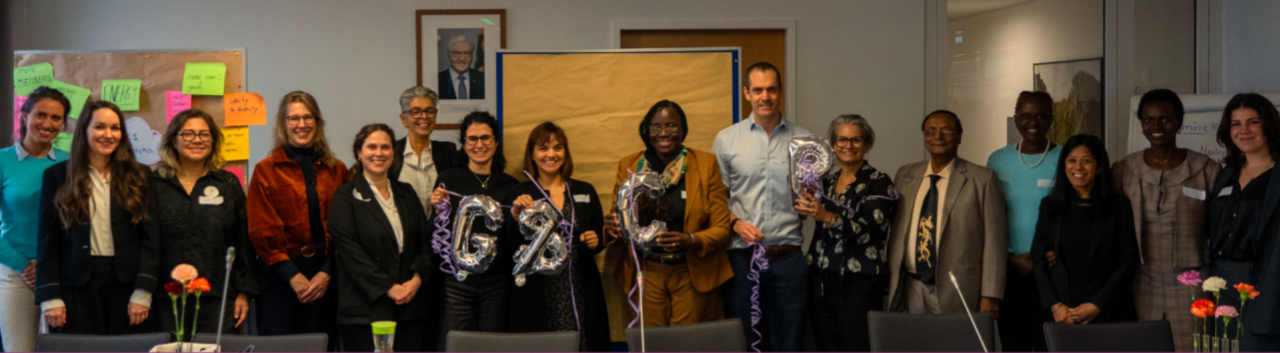
The Gender & Chemicals Partnership was founded at the 5th International Chemicals Conference (ICCM5) in Bonn, Germany, in September 2023. In November 2024 the First Assembly of the G&CP took place in Berlin, Germany.

Empowering Youth for Sustainable Chemistry
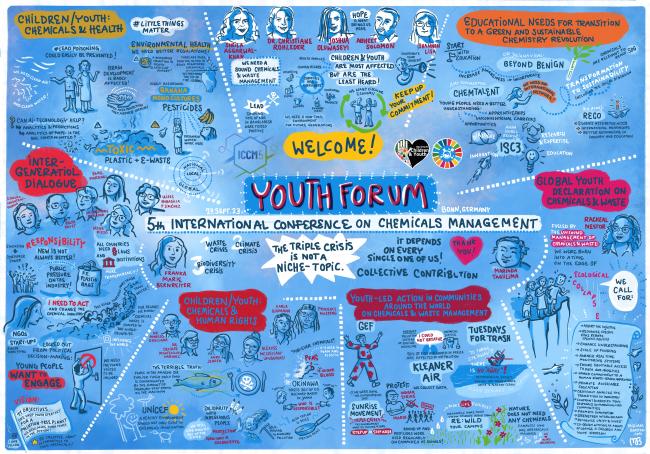
ISC3 actively engages and empowers youth to drive the transition toward Sustainable Chemistry. Through dedicated trainings, dialogue formats, and innovation support, ISC3 provides young people with knowledge, skills, and opportunities to participate in global chemicals governance. A highlight of these efforts was ISC3’s contribution to the first Youth Forum on Che-micals Governance at ICCM5 in Bonn, where ISC3 facilitated discussions, shared expertise, and supported young innovators and start-ups. In collaboration with youth networks and partner organisations, ISC3 continues to create spaces for exchange and capacity building, enabling the next generation to take an active role in shaping a safer and more sustainable chemical future.
Miriam Barton, Chemicals and Waste Youth Platform, displays her graphic summary of the Youth Forum on Chemicals Governance 2023.
Policy & Innovation
Policy work is key to driving the global transformation towards Sustainable Chemistry across actors and sectors. Through dialogue, advisory services, and international cooperation, ISC3 supports the integration of sustainability and innovation into chemical governance and policy frameworks. We engage in European and international processes such as the Global Frame-work on Chemicals (GFC), the Intergovernmental Science-Policy Panel on Chemicals, Waste and Pollution (ISP-CWP), and the implementation of the EU Green Deal, including the Safe and Sustainable by Design (SSbD) framework. ISC3 builds alliances, strengthens networks, and provides policy trainings to empower diverse stakeholders. By connecting science, policy, and practice, ISC3 helps shape safer, more inclusive, and circular chemical systems worldwide.
At ISC3 our policy work is organised around strategic themes that support the global transformation of the chemical sector towards sustainability.

Policy and stakeholder dialogue
Policy and stakeholder dialogue: We convene and support multi-stakeholder forums, webinars and trainings to connect policymakers, industry, science and civil society and advance sustai-nable chemistry in international chemical governance.

Engagement in European and international processes
ISC3 contributes to the implementation of the European Green Deal, the Safe and Sustainable by Design (SSbD) framework and key global instruments such as the Global Framework on Chemicals (GFC) and the Intergovern-mental Science‑Policy Panel on Chemicals, Waste and Pollution (ISP-CWP) to embed sustai-nable chemistry in global chemicals management.

Policy advisory and capacity building
We deliver tailored policy trainings and advisory services to partner organisations, supporting their understanding of regulation, human rights policy, circular economy and innovation in the chemical value chain.

Alliance-building and network development
ISC3 builds global networks of stakeholders inclu-ding under-represented groups, youth and women, to foster inclusive governance, amplify di-verse voices and promote equitable solutions in chemical policy.