Innovation Challenge

Innovation Challenge

Calls for Sustainable Chemistry Innovations

The annual ISC3 Innovation Challenge is thematically oriented along a once-per-year selected focus topic. Start-ups globally are invited to contend for a total of 25,000 EUR in prize money with their innovative ideas that are revolving around the ongoing year’s focus topic.
They are assessed by a jury of international experts who score the Start-ups and choose the finalists. The finalists’ pitches and the award ceremony take place in autumn/winter.

The winners are awarded money prizes in two categories:

  • Two Special Impact Awards for Start-ups that have a noteworthy impact on the environment and society.
  • The overall Winner of our Innovation Challenge.

All the finalists receive a customized support of the ISC3 Global Start-up Service in form of pitch trainings and have the possibility to be featured as Start-up of the Month.

Innovation Challenge 2026

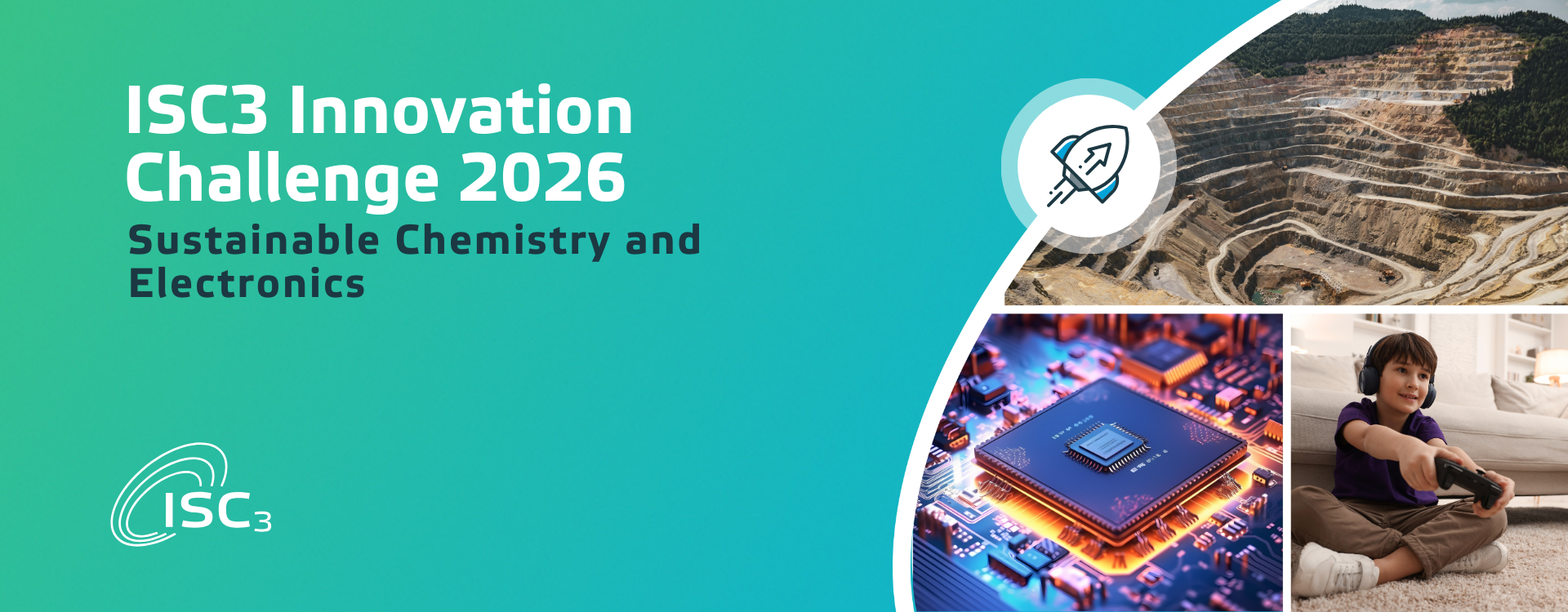
The ISC3 Innovation Challenge 2026 has been announced!

Following the final pitch event held during the ISC3 Investor Forum at the Impact Festival on 26 and 27 November, the topic of the new ISC3 Innovation Challenge 2026 has been announced! This time, it will focus on the topic of Sustainable Chemistry and Electronics.

The next Innovation Challenge will launch from December 12th 2025, 3:00 p.m. CET and will end on May 4th 2026, 0:00 a.m. CET.

Apply here!


Subtopics of the ISC3 Innovation Challenge 2026

Key Focus Areas:

Innovation in Design & Performance:

  • Applying Eco-design principles: designing electronics for durability, repairability, recyclability, and modularity with focus on chemical and materials innovation
  • Design for disassembly: using adhesives, coatings, and encapsulants that can be safely removed or chemically dissolved
  • Reducing material intensity while maintaining performance
  • Developing more sustainable solders, recyclable encapsulants, and solvent systems for safer assembly/disassembly

  • Innovations providing more resource efficient use or substitution of critical raw materials and toxic metal species:

  • Alternative technologies for scarce and critical elements and critical nonrenewable resources (see Annex I a.) for details)
  • Use of abundant, non-toxic, recycled / recyclable feedstocks

  • Sustainable Manufacturing Approaches:

  • Low-energy, low-waste fabrication methods (solution processing, additive manufacturing, green solvents)
  • Designing scalable, safer chemical routes generating less waste
  • Sustainable alternatives to hazardous reagents and byproducts (including additional technologies) (see Annex I b.) for details)
  • Development of biodegradable electronic components using polymers and organic materials
  • Addressing social issues including child labor, unsafe working conditions, and other forms of injustice

  • End-of-Life & Circularity:

  • Chemical methods for disassembly, selective separation, and recycling
  • E-waste recycling and recovery of valuable materials
    • Electrochemical recycling of materials in electronics (e-waste recovery of metals like Li, Co, Au)
    • Mechanical or chemical recycling of plastic materials in electronics
  • Use of recyclable, biodegradable materials or materials that undergo full mineralization at end of life
    • E.g. biomaterials based, biodegradable conductors and semiconductors
  • Closed-loop systems
  • Prevention of material dissipation

  • Alternative & Emerging Materials:

  • Organic and polymer electronics
  • Advanced Materials for Electronics
    • 2D materials like graphene, MoS₂, and MXenes: Surface chemistry affects electronic and mechanical properties
    • Metal–organic frameworks (MOFs) and covalent-organic frameworks (COFs): Used in sensing, energy storage, and optoelectronic devices
    • Self-healing or stimuli-responsive materials for flexible electronics
  • Sustainable alternatives to fossil-based plastic materials used in electronics, e.g.:
    • PVC for cables, insulation, flexible parts
    • ABS for casings for computers, printers, TV’s, keyboards, etc.
    • PS for insulation
    • PC for optical discs, lenses, protective covers, LED


    Novel devices:

  • More sustainable Energy Storage & Conversion Devices (Batteries, Supercapacitors, Fuel Cells)
  • Organic Electronics, Photonics & Optoelectronics(OLEDs, OPVs, Perovskite solar cells, Photocatalytic devices )

  • For more information see: Chemical & Material Specific Criteria

    Submission of proposals:

    Proposals have to be submitted before the indicated deadline. Submissions after the deadline can not be taken into account.

    Eligible participants:

    Eligible are all innovators and entrepreneurs, i.e., persons owning or representing the proposed innovation, employed by organisations including research institutes, start-ups, small-medium sized enterprises, or comparable institutions active in the development and realisation of sustainable chemistry solutions. Enterprises participating in the challenge shall have a staff headcount not exceeding 50 (full time equivalent) and an annual turnover of max. 10 million Euro. Enterprises majority-owned by large enterprises are not eligible for the award, except for innovations leading to the creation of independent spin-offs.Proposals submitted by innovators and entrepreneurs from developing countries and tackling challenges in developing countries are considered as particularly important. Female entrepreneurs are specifically encouraged to submit a proposal.

    Assessment Criteria:

    The proposals will be assessed against the three main criteria:

    • Innovation level. Is the innovation unique, distinct, and truly original?
    • Business viability. What is the market potential of the innovation? Is the idea commercially feasible?
    • Sustainability. What is the sustainability impact of the innovation?

    What to expect? Finalists will receive:

    • Tailored support: access to Global Start-up Service Customised Support
    • Visibility: promotion of your innovation via ISC3 communication channels
    • Networking: participation in the Investor Forum 2026
    • Training: individual and group pitch training for preparation of your Investor Forum 2026 pitch
    • Cash prizes: the overall Innovation Challenge Winner will receive a cash prize of 15,000 EUR. The two separate categories “Best Social Impact” and “Best Regional Impact" OR “Special Impact” are endowed with cash prizes amounting to 5,000 EUR each.

    Schedule:

    Launch of the 2026 Innovation Challenge: Dezember 12th, 2025, 3:00 p.m. CET
    Deadline for proposal submission: May 4th, 2026, 0:00 a.m. CET
    Jury Evaluation: May 6th, 0:00 a.m. CEST – June 16th, 2026, 0:00 a.m. CEST
    Finalist announcements: End of June, 2026
    Finalist pitch training: July-September 2026

    Further information on the Innovation Challenge Award Ceremony will be disclosed in due time.
    ISC3 Innovation Challenge 2025 - Sustainable Chemistry and Climate Change


    Here are the Innovation Challenge Award winners!

    Innovation Challenge 2025 has now officially ended. The winners were announced on Thursday, November 27th, as part of the Investor Forum at Messe Frankfurt on the Impact Festival.

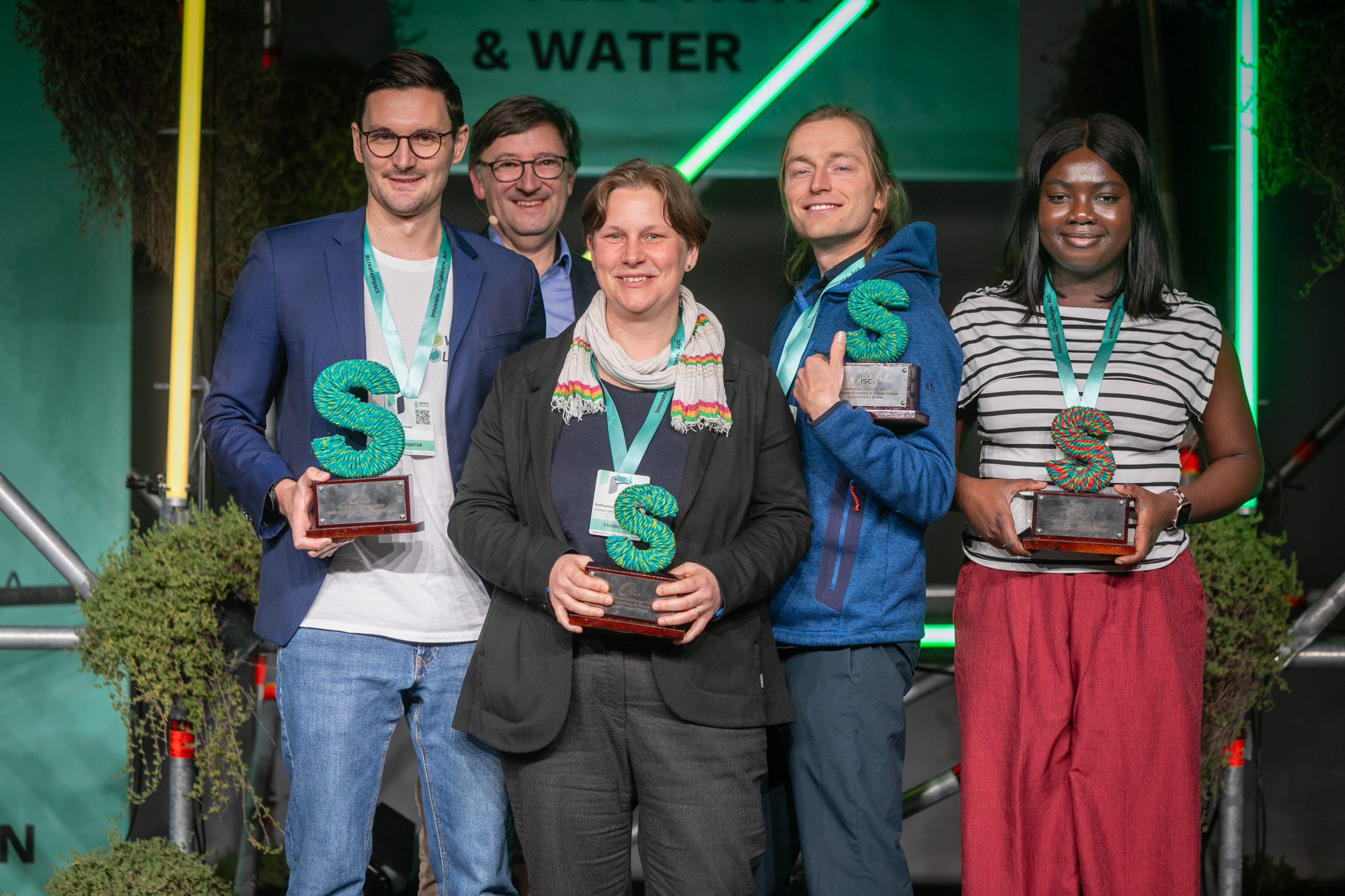
    The Innovation Challenge Award (15.000 €) was given to Power2Polymers from Germany, the two Special Impact Awards (5.000€ each) went to AC Biode from Luxembourg/ Japan and ClimEtSan-OnTheGround from Germany.

    We congratulate the winners, applaud all the great innovative start-ups, heartfelt thanks to our international jury of experts and thank everyone for witnessing this event!

    View our newest press release here

    Winners of the ISC3 Innovation Challenge 2025 - from left to right: representative of Power2Polymers (main winner), ClimEtSan-OnTheGround GmbH (Special Impact), AC Biode (Special Impact), Theseus Development (Audience Award), together with the ISC3 Innovation Hub Director, Dr. Alexis Bazzanella (in the back).

    Past Challenges

    Discover the topics and winners of our past challenges!


    Innovation Challenge 2024: Sustainable Chemistry and Textiles

    Read more about the Innovation Challenge 2024 criteria in our announcement press release.

    Winners:

    Read more about the Innovation Challenge 2024 winners in our press release.


    Innovation Challenge 2023: Agriculture

    Read more about the Innovation Challenge 2023 criteria in our announcement press release.

    Winners:

    • SCHUTZEN, India (Innovation Challenge Award),
    • MAKABI, Croatia (Special Impact)
    • Molepse Bioresources, Kenya (Special Regional Impact)
    • ClimEtSan-OnTheGround, Germany (Honourable Mention)

    Read more about the Innovation Challenge 2023 winners in our press release.


    Innovation Challenge 2022: Waste: Prevention, Valorisation & Management

    Read more about the Innovation Challenge 2022 criteria in our announcement press release.

    Winners:

    Read more about the Innovation Challenge 2022 winners in our press release.


    Innovation Challenge 2021: Renewable Energy

    Winners:


    Innovation Challenge 2019/2020: Sustainable Building and Living

    Winners:

    • ZILA, USA (now ZILA BioWorks, Innovation Challenge Award)
    • EcoAct Tanzania Green Life, Tanzania (Best Social Impact)
    • Ecovon, Ghana (Best Regional Impact)
    • IDEA-TEC, Chile (Best female founder)
    • Mesocarpe, Germany (Best female founder)
    • former Mojau Innoventa, South Africa (Best female founder)
    • Akyas, Jordan (Regionally Impactful, Out-Of-The-Box Solution)