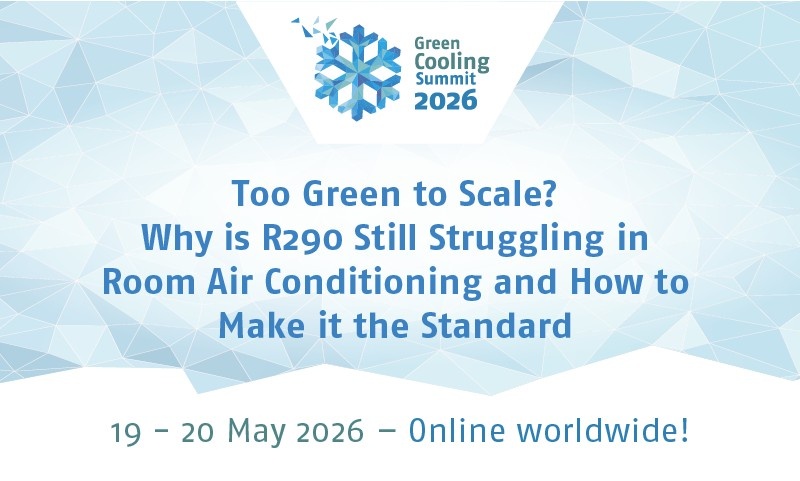
Green Cooling Summit 2026
Online worldwide
With 90 million air conditioners sold annually — and demand rising due to climate change and growing incomes — why is the shift to climate-friendly refrigerants like R290 still so slow?
Join us on 19 and 20 May 2026 to discuss this topic. The virtual summit is jointly organized by the German Environment Agency (UBA) and GIZ Proklima on behalf of the German Federal Ministry for Environment, Nature Conservation and Nuclear Safety (BMUKN) and the Federal Ministry for Economic Cooperation and Development (BMZ).
Key Areas of Focus:
-Best practices: what is working today, how to accelerate transition
-Innovations & trends: what is already working, what will come tomorrow
-Dialogue with sector experts: what to expect along the road
Background
Roughly 90 million single-split air conditioners (ACs) are sold worldwide each year. Sales numbers have doubled over the last 20 years, and the demand keeps growing due to ongoing climate change and increasing incomes in developing countries. Single-split ACs and chillers are used for both cooling and heating purposes and are therefore operating throughout most of the year. With the refrigerant R290 (propane, GWP = 0.02), an efficient, climate- and environment-friendly alternative exists for both ACs and commercial chillers, and the number of manufacturers offering such alternatives is rapidly increasing. Replacing all new split ACs using R32 with technologies using R290 or other natural refrigerants would prevent adding almost 61 M t CO2e of refrigerant banks annually1, while lowering costs and increasing efficiency for the users. Amidst these positive traits and evident benefits, the transition towards R290 and other natural cooling alternatives should be self-going but has yet to take off. Why is the transition not happening?
190 M R-32 (GWP = 675) split-AC units with 1 kg charge size on average equals 60.75 M t CO2e of refrigerant.
Objective
Accelerating the global transition towards sustainable cooling and heating in buildings with natural refrigerants such as hydrocarbons, ammonia (R717), or CO₂ (R744) will benefit both ozone and climate protection and create a foundation for sustainable development – benefitting end-users and manufacturers alike. The GCS 2026 will dissect the barriers to sustainable cooling in buildings and present economic solutions on how to overcome them. Experts from the sector will present already available and scalable technology, innovative financing, and tested policy solutions for upscaling sustainable cooling and heating in buildings. The interactive exchange and dialogue with key stakeholders make the GCS 2026 a starting point for multiplying future collaboration and transformation towards sustainable cooling and heating in buildings.
We are looking forward to welcoming many of you to our Green Cooling Summit 2026!