
dotted world map on blue-green background

Prof. Klaus Kümmerer Co-Edits new Royal Society of Chemistry Book on Chemistry Education for a Sustainable Future

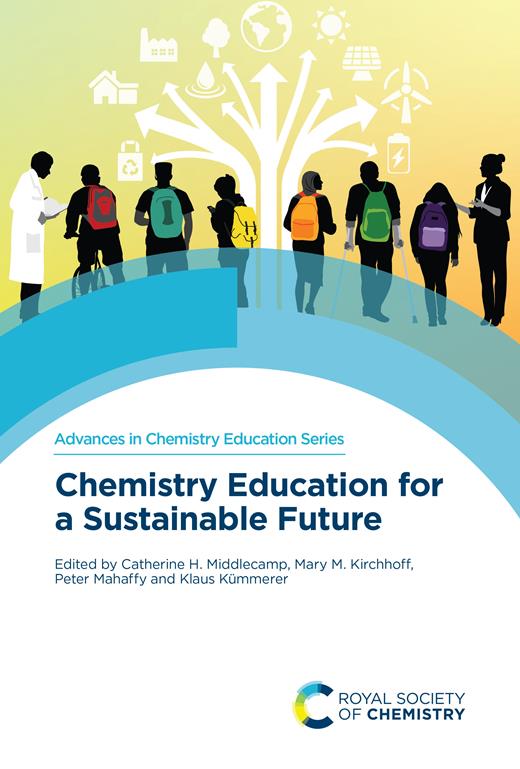
Prof. Dr. Klaus Kümmerer, former Director of the ISC3 Research and Education Hub, is one of the editors of the newly published book Chemistry Education for a Sustainable Future. The volume was released in 2025 by the Royal Society of Chemistry (RSC) as part of the Advances in Chemistry Education Series.

The book is edited by Catherine H. Middlecamp, Mary M. Kirchhoff, Peter Mahaffy, and Klaus Kümmerer and brings together international perspectives on how chemistry education can respond to the global sustainability crisis.
Now and in the years ahead, sustaining life on our planet is one of the defining challenges of our time. Chemistry, as the science of materials and their transformation, plays a central role in addressing this challenge. Yet sustainability-related concepts—such as systems thinking, planetary boundaries, the Sustainable Development Goals (SDGs), and ethical responsibility—are still insufficiently embedded in chemistry education.Chemistry Education for a Sustainable Future addresses this gap by focusing on what today’s students need to learn in order to help people and the planet thrive. The book provides a logical sequence of topics and offers practical strategies to support chemistry educators in equipping students with the knowledge and skills required to contribute responsibly to a sustainable future—as scientists and as citizens.

Orienting chemistry towards sustainability

Prof. Kümmerer also authored Chapter 3, “Orienting Chemistry Towards Sustainability”, in which he examines the historical development of chemistry from a discipline focused primarily on synthesis and product performance toward one that must take responsibility for waste generation, environmental pollution, health impacts, and resource depletion.The chapter connects and critically discusses Green chemistry, Circular chemistry, and Sustainable Chemistry, highlighting both their contributions and their limitations. Prof. Kümmerer emphasises that Sustainable Chemistry goes beyond efficiency improvements or recycling approaches. Instead, it requires systems thinking, precautionary action, ethical and social responsibility, transparency, and a fundamental reduction of overall substance, material, and product flows.A central message of the chapter is that sustainability cannot be achieved through technological innovation alone. Chemistry must be embedded within broader societal frameworks and aligned with planetary boundaries and the SDGs.

PFAS as a case study for sustainability-oriented education

To translate theory into educational practice, the chapter uses per- and polyfluoroalkyl substances (PFAS) as an extensive case study. PFAS—often referred to as “forever chemicals”—illustrate how desirable chemical properties such as stability and resistance to degradation can result in severe long-term environmental contamination and health risks when sustainability considerations are overlooked.Using PFAS, the chapter demonstrates how chemistry education can enable students to:

  • understand unintended consequences of chemical innovation,
  • recognise the limits of Green and Circular Chemistry when applied in isolation,
  • apply life-cycle thinking, precautionary approaches, and sound chemicals management.

The chapter also offers concrete guidance for integrating sustainability topics into chemistry curricula, including suggested learning outcomes, teaching activities, and examples suitable for foundational and advanced courses.

Read here