A high-flying vision
"I guess sustainability is something I've always been working on,"
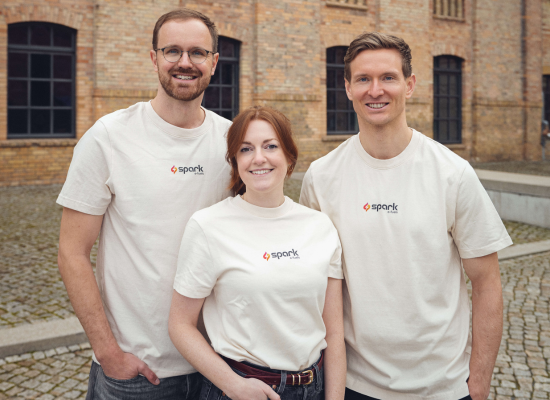
states Dr. Mathias Bösl, CEO of Spark e-Fuels. Mathias has dreamed of founding a start-up since his PhD at the Max Planck Institute for Plasma Physics in Munich. Although his work on nuclear fusion strengthened his interest in deep technological challenges, he felt that his highly theoretical studies lacked real-world impact. He wanted to make a tangible difference for the planet with his knowledge. Sustainability was a core motivator: “For me, it is a core requirement and my main reason to found a start-up,”
Mathias explains.After completing his PhD, Mathias worked as a consultant at BCG to develop economic skills and build his network. In 2021, he assembled a team whose expertise complemented his own: Dr. Arno Zimmermann, now CPO, who was analyzing the techno-economics of e-fuel production at MIT, and Dr. Julia Bauer, CTO, a chemistry PhD who was then working as a process engineer at Evonik.
The team’s path differed from many other start-ups. Instead of pushing an existing technology, they adopted a market-driven approach, seeking a suitable customer problem first. This involved extensive market research, including interviews with potential customers. They discovered that the process behind e-fuel synthesis had significant room for optimization — especially identifying high electricity costs as the main limiting factor. Additionally, the timing was right as the EU began actively promoting e-fuel mandates for aviation. With this insight, the team started developing a solution.
“In the beginning, we aimed to cover more of the full value chain and act as integrators of partly existing technologies. But then we realized there was no load-flexible technology available for our needs, so we had to develop our own,”
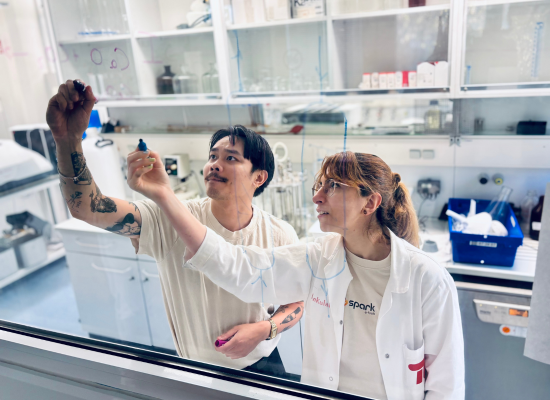
Mathias explains.Today, Spark e-Fuels counts 10 team members plus angel investors, supported by both public and equity funding. Besides financing the expensive technology, challenges included scaling up lab-proven technology to industrial levels. The company is currently preparing its first pilot production, expected to be operational at the beginning of 2026.
The name Spark e-Fuels reflects the team’s goal: to spark and accelerate the development of sustainable fuels powered by renewable electricity, a vision symbolized in their logo.
Fuelled by impact, not fossil fuel
Planes enable fast travel, connect distant regions, and drive globalization, making them a defining feature of modern life. However, conventional planes run on non-renewable fossil fuels, which are major sources of greenhouse gases and air pollution, with aviation contributing around 4% to global warming to date. Alternative fuels exist but face major challenges or lack large-scale implementation. For example, biofuels derived from biomass compete with food production for land.
The theoretically most sustainable solution is electro-fuels (e-fuels), where renewable electricity powers electrolysis to split water into hydrogen, which is then combined with captured CO₂ to synthesize liquid fuel. The challenge is that these processes conventionally require stable, high-energy input — something intermittent renewable sources like wind and solar cannot reliably provide. Alternatively, a large hydrogen buffer is needed to balance fluctuations. Traditional e-fuel production and hydrogen storage are extremely energy-intensive and costly, and large-scale commercial production has not yet been realized.
Spark e-Fuels has revolutionized this process. The start-up developed a load-flexible, demand-responsive production system that buffers energy intermittency without the need for massive hydrogen storage. Their core innovation lies in their first conversion step, using the reverse water-gas shift (RWGS) reaction to convert carbon dioxide and water into a syngas mixture of hydrogen and carbon monoxide. Their process operates at lower temperatures and achieves much higher CO₂-to-CO conversion than conventional processes.
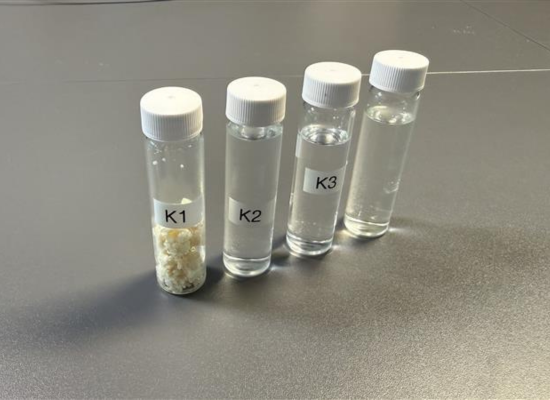
In the second step, carbon monoxide and hydrogen are converted into liquid fuels via the Fischer-Tropsch (FT) reaction. By tightly integrating these synthesis steps, Spark enables efficient, flexible fuel production that adjusts dynamically to the available hydrogen supply.
“We base our concept on reactor principles that are highly scalable, which is essential for real impact,”
explains Mathias Bösl, CEO of Spark e-Fuels.Using captured CO₂ and green hydrogen, this approach offers a realistic, net-zero pathway for producing e-fuels, promoting more sustainable industrial practices in aviation and chemical sectors. The lower costs achieved further support scalability and accessibility, aiming to transform hard-to-decarbonize sectors like aviation with modern, clean energy solutions.
Next up at Spark e-Fuels
Spark e-Fuels is currently focused on its pilot production plant, which is expected to be operational early this year. Following this milestone, the next phase will be building a larger demonstration plant. To achieve this, they plan to secure additional funding, find a suitable location, and establish new partnerships. In the long term, the start-up aims to sell its technology to e-fuel production projects, helping to make e-fuels accessible for aviation worldwide.
With their innovative approach, Spark e-Fuels, who joined the ISC3 Global Start-up Service as one of the Innovation Challenge finalists in Sustainable Chemistry and Climate Change in July 2025, actively contributes to SDG7 (Affordable and Clean Energy), SDG9 (Industry, Innovation and Infrastructure), SDG12 (Responsible Consumption and Production), SDG13 (Climate Action).