The driving forces behind Alkyl Recycling
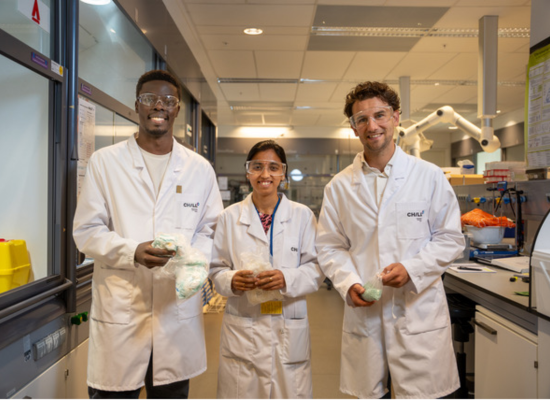
According to a study by the Ellen McArthur Foundation, more than 40 million tons of absorbent hygiene products are produced worldwide every year. The demand for disposable diapers and incontinence products continues to rise. According to the European Commission, waste from these sources totals 8.5 million tons per year in Europe, which has considerable environmental impacts and high costs for landfilling or incineration. Founder Melvin Kizito is working to take a leadership role in the sustainable chemical recycling of complex waste streams and set new standards in the waste industry. More than five years after being awarded "Best Regional Impact," we spoke with Alkyl about their progress, milestones, and the role of support from the ISC3 Global Start-up Service.
What does Sustainable Chemistry mean to you?
Sustainable Chemistry is the key for us to make the waste management sector more sustainable, environmentally friendly, and circular. Sustainable Chemistry can provide the waste management sector with the much-needed processes that are safe, scalable, cost-optimised, and resource-efficient. By following the ISC3 Key Characteristics of Sustainable Chemistry, we can turn diaper waste, traditionally considered non-recyclable, into valuable raw materials with lower environmental impact, in a way that is also economically viable for recyclers. The recovered components are reused in the production of paper, textiles, construction materials, and other products.
Where do you stand today compared to when you were awarded Startup of the Month and won the "Best Regional Impact" award at the ISC3 Innovation Challenge?
Since then, Alkyl Recycling has made significant progress in building strong commercial partnerships with waste management companies, municipalities, material buyers, and machinery providers. The ISC3 has helped raise our visibility with potential customers and partners and provided us with credibility. We have expanded our team to include additional specialists in chemistry and engineering, bringing our total staff count to 6 with a mix of full-time staff and advisors. On the technical side, we have successfully conducted several industrial trials with key partner companies and validated our process on an industrial scale. We have proven in practice that we can combine energy efficiency with superior material recovery, providing an economic advantage to companies. Additionally, we gained deeper insights into the diaper value chain, which have been incorporated into the development of our first pilot plant, set for commencement in 2026. The plant will have a capacity of one ton per day.
How have you benefited from collaborating with the ISC3 and the support provided by the ISC3 Global Startup Service?
The ISC3 Global Startup Service has been extremely valuable for Alkyl Recycling, especially for expanding our network and further strengthening our business case. During the ISC3 Investor Forum, we were introduced to a variety of investors. Through this network, we connected with corporate venture companies and material buyers. At ACHEMA, we also had the opportunity to meet with leading machinery manufacturers. This technical exchange was crucial for the development of our pilot plant concept and for finding the right partners for scaling. The strong presence of the ISC3 on social media and in the press has also provided us with visibility and credibility, opening many doors. The prize money from being awarded the "Best Regional Impact" title has been a valuable resource, which we invested successfully in market validation experiments and technical testing.
What have been the highlights of your projects so far?
We have been able to turn our idea, which had been proven in the lab, into a marketable product that has been successfully tested in the field and recognised by our partners. In mid-2024, we secured funding from the Limburg Province Economic Development Organization (LIOF), which has been instrumental in scaling our technology into a functional prototype and continuing to optimise it. Our next major step is the construction of our unique pilot plant, which will provide crucial insights for the planning and launch of a fully commercial demonstration plant.
What does all of this mean for your company?
We have made our vision marketable. Specifically, we have proven that we can effectively separate diaper materials into valuable, high-quality materials through a cost-efficient process. This achievement gives us a competitive edge, as we combine energy efficiency with superior material recovery and capitalise on the economic advantages of our technology. The fact that we will soon be able to contribute to a more environmentally friendly and circular recycling approach in the waste sector on a commercial scale is our greatest success and the most satisfying aspect of our work.